
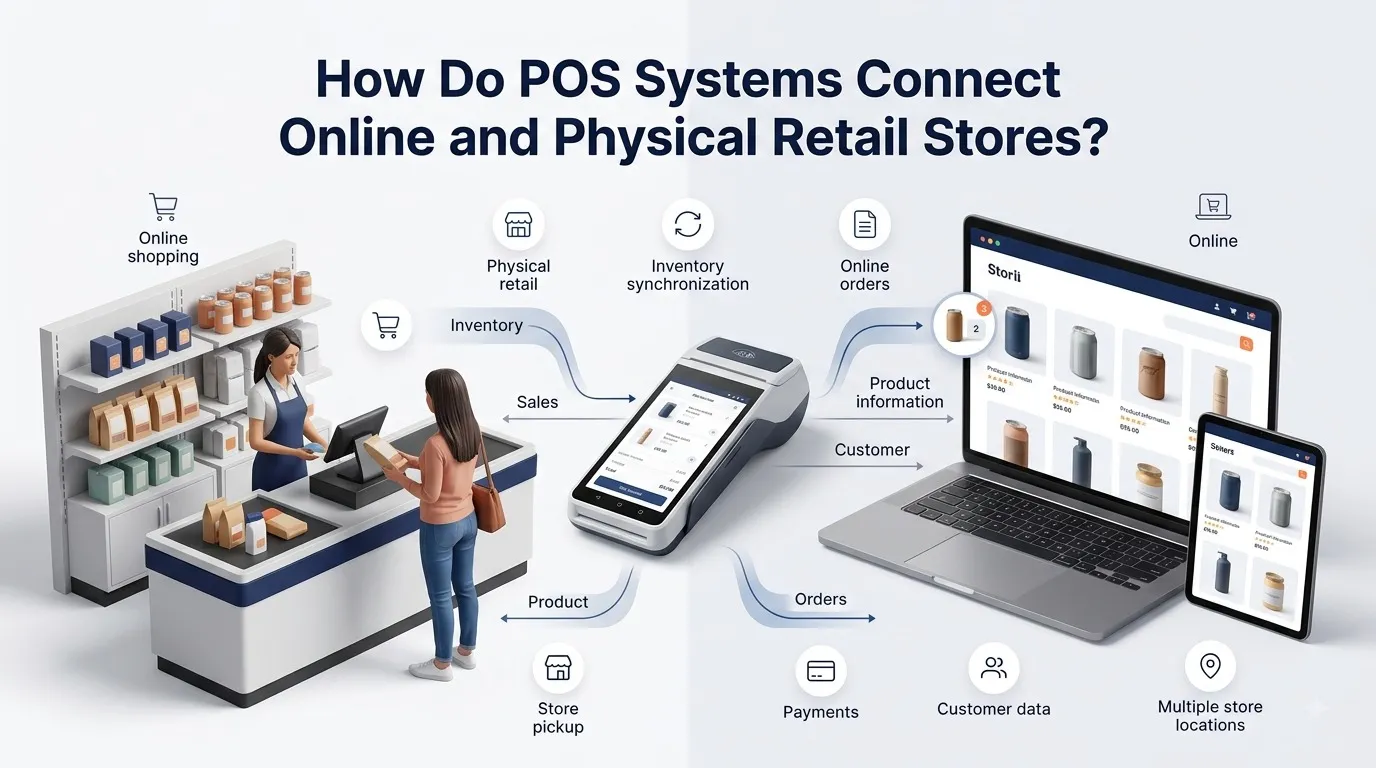
POS Systems Connect Online and physical retail stores by synchronizing sales, inventory, product, and customer data across different selling channels. Instead of managing the online store and physical location as separate businesses, retailers can use an integrated POS system to keep information consistent across both. This helps prevent inventory errors, improves order management, gives employees better visibility, and creates a more consistent customer experience.
For example, when a customer buys the last item in a physical store, the inventory count can update across connected channels. When another customer checks the same product online, they see the updated availability rather than an outdated stock number. USPayrun’s retail POS solution supports this type of multi-channel setup by syncing sales, inventory, and customer data between physical and online stores.
Why Do Retailers Need to Connect Online and Physical Stores?
Customers no longer shop through only one channel.
A customer may discover a product through Google, check its availability online, visit a physical store to see it, and complete the purchase at the register. Another customer may order online and choose store pickup.
When these channels operate separately, information can become inconsistent.
An integrated POS system gives the retailer one connected view of its sales and inventory. This makes it easier to manage products regardless of where the customer places the order.
How Does a POS System Sync Online and In-Store Inventory?
The POS system updates inventory as products are sold.
When an item sells in a physical store, the available quantity can be updated for connected online channels. Online sales can update the same inventory information.
This reduces the need for employees to manually update stock across multiple systems.
USPayrun highlights real-time inventory management as a core retail POS capability, including stock tracking, low-stock notifications, barcode-based updates, and inventory reporting.
The result is a more accurate picture of what the business actually has in stock.
Can a POS System Prevent Overselling Online?
Yes, an integrated POS system can help reduce overselling by keeping inventory information synchronized across sales channels.
Imagine a retailer has three units of a product available. One sells in the physical store. The connected inventory system can update the available quantity for the online store.
Without synchronization, the website could continue showing three units even though only two remain.
Inventory synchronization doesn’t eliminate every stock discrepancy, but it gives retailers a much stronger system for managing availability across channels.
How Does POS Integration Improve the Customer Experience?
Customers get more accurate information and more flexible ways to shop.
They may be able to check product availability online, purchase in-store, order online, or use services such as store pickup when the retailer’s systems support them.
The experience feels more consistent because the same product and inventory information supports different customer touchpoints.
A connected POS system can also speed up checkout through quick transaction processing and integrated payment options. USPayrun’s retail POS supports credit and debit cards, gift cards, NFC, and mobile payments.
How Does POS Integration Support Buy Online, Pick Up In-Store?
Buy online, pick up in-store (BOPIS) depends on accurate communication between the online store and physical location.
A customer places an order online. The retailer needs to know whether the product is available, where it is located, and whether the order is ready for collection.
An integrated system helps connect these steps.
The exact BOPIS workflow depends on the retailer’s e-commerce platform, POS software, inventory setup, and order management process. But the underlying principle is the same: online and physical operations need access to consistent information.
Can Customers Return Online Purchases In-Store?
They can when the retailer’s systems and policies support cross-channel returns.
A connected POS system can give employees access to transaction information needed to locate an online purchase and process the return.
This is useful because customers don’t necessarily think in terms of separate sales channels. They think of the retailer as one business.
A connected system helps the retailer deliver that same experience.
How Does POS Integration Help Employees?
Employees don’t need to manage completely separate information for online and physical sales.
A connected system can give them access to product information, inventory levels, transactions, customer information, and sales data from a central platform.
This helps employees answer questions such as:
“Do we have this size at another location?”
“Is this item available online?”
“Was this order already purchased?”
“Can I process this return?”
Better access to information means fewer manual checks and faster customer service.
How Does a Connected POS System Improve Inventory Management?
Inventory management becomes easier because sales from different channels contribute to the same stock information.
Retailers can track products by SKU, monitor stock levels, identify low-stock products, and review inventory reports.
USPayrun’s retail POS supports product variants and combinations, barcode-based inventory updates, low-stock notifications, and detailed inventory reporting.
This is especially useful for retailers with many products, sizes, colors, or locations.
How Does POS Integration Help Retailers Understand Sales?
Connected sales data gives retailers a broader view of business performance.
Instead of looking at online sales and store sales separately, retailers can analyze sales activity across channels.
This helps answer important questions.
Which products sell best online?
Which products perform better in stores?
When do customers buy the most?
Which products are frequently out of stock?
Which locations generate the most sales?
USPayrun’s retail POS provides sales reporting and analytics to help retailers monitor sales trends and make business decisions.
Can POS Systems Connect Online With E-Commerce Platforms?
Yes,POS Systems Connect Online with e-commerce platforms . POS systems can integrate with e-commerce platforms and other business software.
The exact integration depends on the POS provider, online store, and available connectors.
USPayrun specifically promotes multi-channel integration and uses SKU IQ to sync sales, inventory, and customer data between physical and online stores. Its platform also offers a native online store solution and product visibility through Google with Pointy.
This gives retailers more options for managing different sales channels without maintaining every system separately.
How Does Cloud-Based POS Technology Support Multiple Locations?
Cloud-based POS technology allows authorized users to access business information from different locations.
A retailer with several stores can use centralized information to monitor sales, inventory, employees, and other operations.
USPayrun states that its cloud-based POS provides secure access to business data from anywhere.
This gives owners and managers better visibility without requiring them to be physically present at every location.
What Happens When the Internet Goes Down?
Some POS systems support offline payment processing so stores can continue operating during temporary connectivity problems.
USPayrun states that its retail POS can continue processing payments offline and synchronize information after the connection returns.
The exact offline capabilities depend on the POS and payment configuration, so retailers should confirm these details before choosing a system.
How Does USPayrun Connect Online and Physical Retail?
USPayrun’s retail POS solution is designed to support retailers that sell through multiple channels.
It provides tools for inventory management, payments, sales reporting, customer data, and multi-channel integration. The platform states that sales, inventory, and customer data can be synchronized across physical and online stores.
This gives retailers a more connected way to manage the business while giving customers a more consistent shopping experience.
Want to POS Systems Connect Online and physical retail operations? Talk to USPayrun about a retail POS system that fits your store, sales channels, and day-to-day workflow.
What Should Retailers Look for in a Connected POS System?
Retailers should look beyond the checkout screen.
A useful connected POS system should support accurate inventory management, payment processing, sales reporting, customer data, e-commerce integration, security, and employee workflows.
Integration is especially important. A POS system that cannot communicate effectively with the retailer’s online store can create another layer of manual work.
Scalability matters too. The system should support the business as it adds products, sales channels, employees, or locations.
The right POS system should connect the parts of the retail business that customers already experience as one.
Frequently Asked Questions
Can a POS Systems Connect Online store with a physical store?
Yes,POS Systems Connect Online store with a physical store. An integrated POS can synchronize sales, inventory, and customer data across online and physical retail channels.
Does POS integration update inventory automatically?
It can. Connected systems update inventory as transactions occur, helping retailers maintain more accurate stock information.
Can a POS system support multiple retail locations?
Yes. Many POS platforms support centralized management across multiple stores, depending on the system and configuration.
Can USPayrun connect online and physical retail stores?
Yes. USPayrun states that its retail POS can synchronize sales, inventory, and customer data across physical and online stores.
Why is POS integration important for retailers?
POS integration reduces disconnected data, improves inventory visibility, and helps retailers provide a more consistent shopping experience across channels.
Related US Payrun solutions
Questions about a POS system for your business? Call (860) 844-3611 or request a free trial.