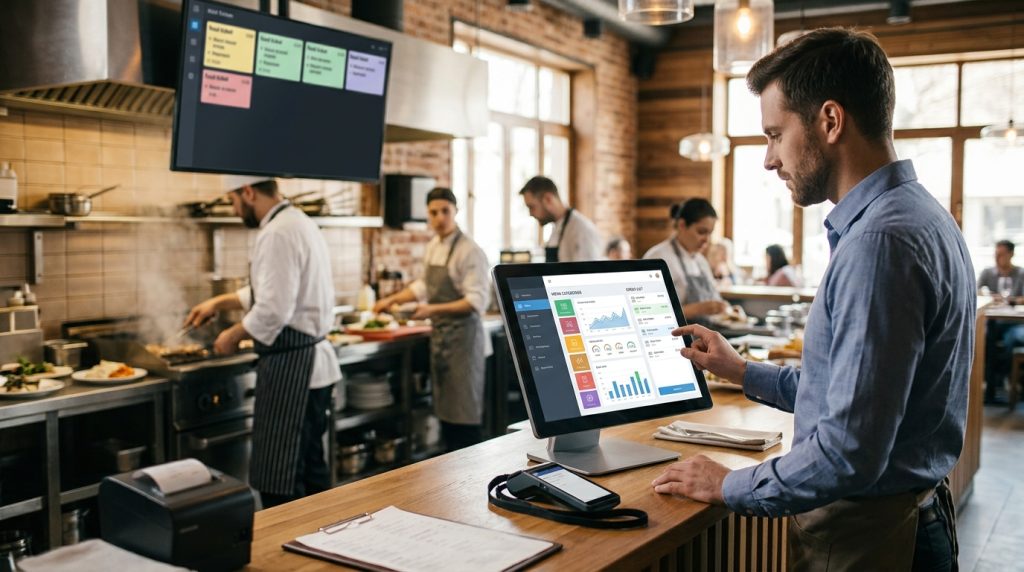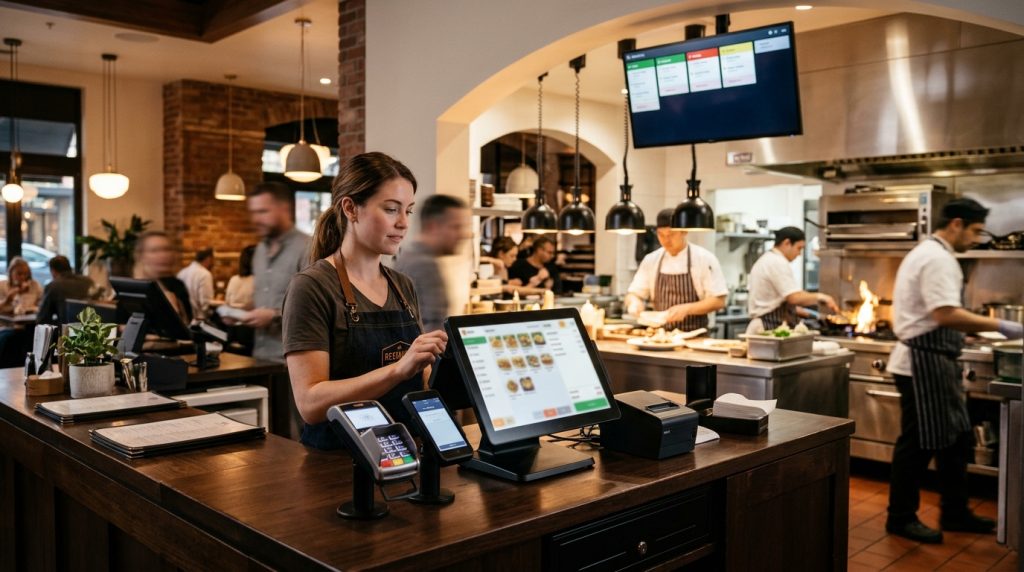

Restaurant payment processing is the system that allows restaurants to accept credit cards, debit cards, mobile wallets, and online payments from customers. It connects the restaurant’s point-of-sale (POS) system, payment processor, card networks, and banks to authorize transactions and transfer funds into the restaurant’s account.
For restaurant owners, payment processing is more than accepting a card at checkout. Processing fees, transaction speed, payment security, settlement times, and POS compatibility all affect daily operations and operating costs. Choosing the right payment processing solution helps restaurants manage transactions, track sales, and serve customers through different payment channels.
This guide explains how restaurant payment processing works, the common payment methods, processing fees, and the features to consider when choosing a provider.
How Restaurant Payment Processing Works
A restaurant payment transaction involves several parties working together. The customer provides a payment method, the restaurant’s POS system sends the transaction details to a payment processor, and the processor communicates with the relevant card network and issuing bank.
The process usually follows five stages.
1. Customer Selects a Payment Method
A customer chooses a payment method for the bill. The customer may pay with a credit card, debit card, mobile wallet, or online payment. For table service, servers bring the bill to the table. For counter service, customers pay at the register.
2. The Card Is Read or Information Is Entered
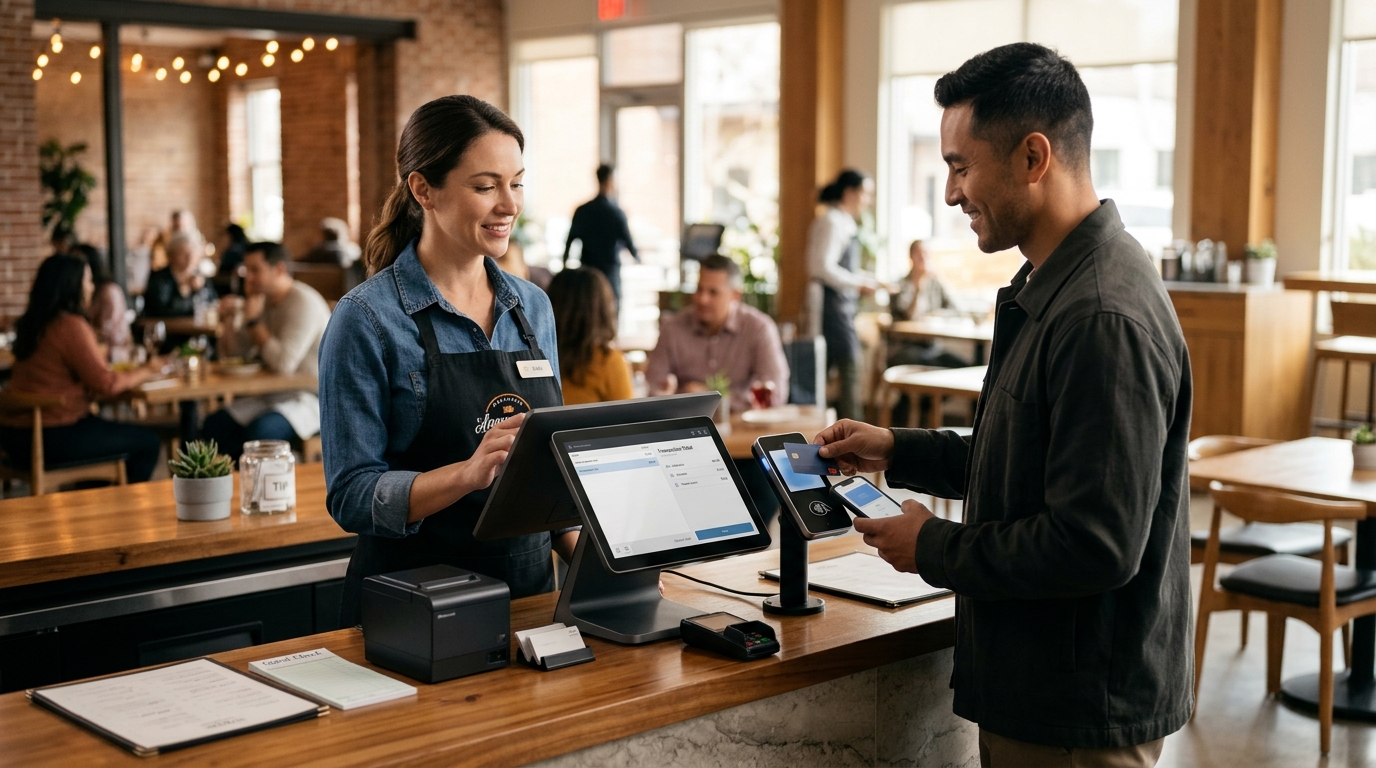
The customer inserts or taps a card at the payment terminal. Restaurants may also accept mobile wallets on compatible devices. For online orders, customers enter payment information through a website or supported app.
3. The Payment Processor Routes the Transaction
The transaction is sent to a payment processor for authorization. The processor contacts the appropriate card network and the issuing bank. The card issuer verifies that the card is valid and the funds are available.
4. Authorization and Confirmation
The issuing bank approves the transaction and sends confirmation back through the card network and processor to the POS. The restaurant can then finalize the order and, if needed, provide a receipt.
5. Settlement and Funding
The restaurant gathers approved transactions and sends them to the processor, usually at the end of the day, for settlement. The funds are transferred to the restaurant’s account after processing fees and deductions. Settlement typically takes one to two business days. Offline mode, where supported, allows the restaurant to continue processing transactions when the internet is unavailable and submit them later.
Restaurant Payment Methods
Restaurants typically accept several payment methods, depending on their service model. The best setup provides consistent processing for counter service, table service, online orders, and delivery.
Credit and Debit Card Payments
Credit and debit cards are the most common payment methods in restaurants. Customers insert or tap the card, and the terminal sends the transaction for authorization. EMV chip cards are widely used, and contactless cards are supported when the terminal is enabled.
Restaurants often use this method for service because it is fast and familiar to customers.
Contactless Payments
Contactless payments allow customers to pay by tapping a card or supported device near a compatible payment terminal.
This method offers a quick checkout experience for customers. It also reduces the need for physical contact with the terminal during the transaction. Contactless payments use tokenization and security features to protect payment information.
Mobile Wallets
Mobile wallets allow customers to pay using smartphones, smartwatches, and other supported devices. Popular options include Apple Pay and Google Pay.
These payments use tokenization and other security features to protect payment information during transactions. Restaurants need compatible terminals to accept contactless mobile wallet payments.
Online Payments
Online payments allow customers to pay when placing orders through a restaurant website, mobile app, or supported ordering platform.
The payment gateway securely collects and transmits payment information for authorization. Online payment processing is important for restaurants that offer takeout, delivery, and direct ordering.
Cash Payments
Cash remains a payment option for restaurants that serve customers who prefer physical currency. Unlike card transactions, cash payments do not require card network authorization or electronic payment processing.
However, restaurants still need accurate cash registers, transaction records, and cash management procedures.
Restaurant Payment Processing Fees Explained
Payment processing fees are the charges restaurants pay to accept electronic payments. The total cost depends on the payment method, card type, processor, pricing structure, and transaction environment.
Understanding these charges helps restaurant owners compare providers and calculate the actual cost of accepting card payments.
Interchange Fees
Interchange fees are paid to the bank that issued the customer’s card. Card networks establish interchange rates based on factors such as card type, transaction method, and merchant category.
For example, a premium rewards credit card and a standard debit card may carry different interchange rates. These fees are generally the largest cost component in payment processing.
Assessment Fees
Assessment fees are charged by card networks for using their payment network. These fees are based on the transaction volume and card type. Restaurants cannot negotiate assessment fees because they are set by the card networks.
Processor Markup Fees
Processor markup fees are the charges that payment processors add for handling transactions. The markup covers services such as authorization, settlement, reporting, access to the merchant dashboard, and customer support.
Processor markup fees vary by provider and pricing model. Interchange-plus pricing may include a combined flat rate and percentage markup, while flat-rate pricing includes the markup in a single rate.
Other Common Fees
Processing fees may include additional charges depending on the provider. Common charges include:
- PCI compliance fees: charges related to security requirements and the maintenance of payment card data.
- Monthly fees: a recurring charge for account maintenance and access to the platform.
- Chargeback fees: charges triggered when a customer disputes a transaction.
- Equipment and terminal charges: one-time or monthly charges for the payment hardware.
Restaurants should review all potential fees with a provider before signing a contract.
Payment Processing Pricing Models
The pricing model determines how a restaurant’s processing fees are calculated. The four most common models are flat-rate pricing, interchange-plus pricing, tiered pricing, and cash discount programs.
Flat-Rate Pricing
In flat-rate pricing, the processor charges the same percentage and per-transaction fee for every card transaction, regardless of card type.
The advantage of this model is that it is simple to understand and forecast. It works well for restaurants with small transaction volumes. However, it may cost more over time for high-volume operations because it applies the same rate to all transactions.
Interchange-Plus Pricing
Businesses pay the actual interchange fee plus a fixed processor markup. The fee depends on the card type and transaction details.
For example, a premium rewards credit card has a different interchange rate than a standard debit card. This pricing model may be suitable for businesses that regularly process large transactions.
Use this pricing model when your transactions vary in card mix and volume. It tends to be more transparent, but it is more complex to reconcile.
Tiered Pricing
In tiered pricing, transactions are categorized into qualified, mid-qualified, and non-qualified tiers based on the card type and transaction method. The processor applies different rates to each tier.
Tiered pricing can be difficult to predict because the processor defines the tier rules. Restaurants may need more detailed statements to reconcile transaction fees.
Cash Discount Programs
Cash discount programs apply a service fee to card payments so that the business can offset its processing fee. Customers who pay by cash receive a reduced price.
Restaurants should review the rules for cash discount programs in the relevant jurisdiction. Some providers offer a cash discount option as an alternative to paying processing fees.
How to Choose a Restaurant Payment Processing Provider
Choosing a provider involves both costs and operations. It affects the type of payments you accept and the reporting and support options available to you. The following factors help owners evaluate payment processing providers.
Payment Processing Features to Evaluate
Restaurant owners should check whether the provider supports the payment methods that customers use. The platform should support counter service, table service, online ordering, and delivery payments.
- Payment method coverage: The provider should accept credit cards, debit cards, contactless payments, mobile wallets, and online payments.
- Offline mode: The POS should continue to process transactions during internet outages when supported by the provider and hardware.
- Usability: The POS should provide an easy interface for staff.
- Settlement speed: Understand when funds will be available after transactions are processed.
- Reporting: The provider should deliver sales, payment method, refund, and settlement reports.
- Hardware compatibility: Countertop and handheld payment terminals should be supported.
- Customer support: Assistance should be available during business hours and outside normal hours.
Direct communication with the provider can also provide details of service terms, payment hardware, and available support.
Payment Processing Security and Compliance
Restaurants must protect cardholder data to meet industry requirements. Payment processors should support security controls and compliance with the Payment Card Industry Data Security Standard (PCI DSS). Key security measures include:
- PCI DSS compliance: Processors should follow the Payment Card Industry Data Security Standard to protect card data.
- Tokenization: Replaces card numbers with tokens to protect sensitive information.
- Encryption: Protects card data during transmission.
- Fraud monitoring: Tracks transaction patterns and detects suspicious activity.
Integrated POS and Payment Processing
An integrated POS system combines order management, payment processing, reporting, and inventory management in one platform. Integrated POS systems offer several advantages:
- Real-time inventory changes: Inventory updates can be maintained from sales information.
- Unified reporting: Sales and payment activity can be viewed from one reporting area.
- Faster settlement: Integrated systems can help payments settle faster when supported.
For restaurants, an integrated system can reduce manual work and support consistent sales records.
How to Reduce Restaurant Payment Processing Costs
Reducing processing fees requires a balanced review of costs and operations. The following steps can help restaurants manage their payment expenses:
- Review your current pricing model and fee structure.
- Consider interchange-plus pricing for high-volume transactions.
- Ask about processing software and hardware costs before choosing a provider.
- Consider whether batching transactions and avoiding chargebacks could help.
- Use available reporting to identify high processing costs and payment methods that affect costs.
- Ask about support options and settlement times, as faster settlement can affect cash flow even if fees remain higher.
- Where required, consider a cash discount program only after checking local requirements.
Lower fees do not always mean lower processing costs. Restaurant owners should compare the full range of processing services before deciding.
Get Restaurant Payment Processing Through USPayrun
USPayrun offers payment processing solutions for restaurants, including POS-integrated processing and online payment tools. USPayrun’s product options for restaurant payment processing include countertop payment terminals, the Wing 15.6-inch dual-touch POS at $799, and the Wing 15.6-inch touch POS at $699. It also sells a countertop payment terminal for accepting customer payments.
Visit USPayrun to see the restaurant payment processing, POS, and payment gateway options available for restaurants.
To learn more about USPayrun’s restaurant payment processing options, call (860) 844-3611.
A restaurant payment processing solution should give a clear picture of fees, payment methods, settlement times, and security. A restaurant should choose the provider setup that supports its service style and helps the business manage transactions. When the business grows, the payment setup should be reviewed and updated.
Frequently Asked Questions About Restaurant Payment Processing
1. What is restaurant payment processing?
Restaurant payment processing is the system that allows a restaurant to accept credit cards, debit cards, mobile wallets, and online payments. The process involves the restaurant’s POS system, a payment processor, card networks, and issuing banks working together to authorize and settle transactions.
2. How are restaurant payment processing fees calculated?
Fees depend on the interchange fee, the assessment fee, and the processor markup. The pricing model, such as flat-rate, interchange-plus, or tiered pricing, also affects the total cost.
3. How long does it take for a restaurant to receive payments?
Settlement usually takes one to two business days after the end-of-day batch. Settlement times may vary by provider and banking arrangement.
4. Can restaurants accept mobile wallet payments?
Yes, if the restaurant has a compatible payment terminal. Mobile wallet options, such as Apple Pay and Google Pay, rely on contactless payment technology.
5. Is integrated POS payment processing better for restaurants?
An integrated POS system combines payment processing, reporting, and inventory management in one platform. It can simplify daily operations by reducing manual reconciliation between separate systems.